
In the Copic vs Tombow vs Posca vs Pigma Micron matchup, four brands are not competing for the same job: these are four different tools. Copic is an alcohol marker for colouring with smooth gradients; Tombow is a water-based brush pen, ideal for lettering and light colour; Posca is an opaque acrylic paint marker for highlights and details on almost any surface; and Pigma Micron is a pigment ink fineliner for inking lines. If you are wondering which markers to buy for illustration, the short answer is: a Micron for line work and then Copic or Tombow for colour, depending on your budget and your paper.
If you want an overview of every type of marker, you will find it in our guide to the best markers for illustration. Here we get straight to the head-to-head differences: ink, blending, opacity, paper, refills and which jobs each one wins.
In short
- Copic Ciao: alcohol ink, the smoothest blends and refillable. The best choice for colouring illustration and comics with a professional finish.
- Tombow Dual Brush Pen: water-based ink, a flexible brush tip and blending with water. The most versatile option for lettering and light colour.
- Posca PC-3M: opaque water-based acrylic paint. The only one of the four that covers dark colours and works on wood or fabric.
- Sakura Pigma Micron: water-resistant pigment ink in several line widths. The foundation for inking before you colour.
- They do not replace each other: the most common combination is Micron for line, Copic or Tombow for colour and Posca for final highlights.
Copic vs Tombow vs Posca vs Pigma Micron: comparison table
| Feature | Copic Ciao | Tombow Dual Brush Pen | Posca PC-3M | Sakura Pigma Micron |
|---|---|---|---|---|
| Ink type | Alcohol | Water-based | Water-based acrylic paint | Pigment ink |
| Tips | Brush and chisel | Brush and fine tip | Fine bullet tip | Fine tip, several widths |
| Blending and gradients | Excellent, no streaks | Good, with water or a blender | In layers, once dry | Does not blend, it is for line |
| Opacity | Transparent | Transparent | Very opaque | Deep black line |
| Ideal paper | Marker paper or thick smooth paper | Smooth, not too textured | Paper, card, wood, fabric | Smooth, almost any sketchbook |
| Bleeds through paper | Yes, easily | Slightly | Slightly | No |
| Refillable | Yes, ink and nibs | No | No | No, disposable |
| Approximate price | Most expensive per pen | Mid-range | Mid-range | Low per pen |
| Best use | Colour for illustration and comics | Lettering and light colour | Highlights, details and customising | Inking and line drawing |
Compare these 4 products side by side
Copic Ciao: the alcohol marker for colouring
Copic markers are the standard for marker illustration. Their alcohol ink stays wet on the paper for a few seconds, so you can melt one tone into another without visible strokes. That is what produces the clean gradients on skin, fabric and volumes you see in comics, manga and character design.
The Ciao range has a dual tip, brush and chisel, and it is refillable: when a colour runs dry you top up the reservoir with ink, and you can swap the nibs when they wear out. In the long run, that offsets its starting price, which is the highest in this comparison.
Copic weak points
- It bleeds through. Alcohol ink goes through most sketchbooks, so always put a sheet underneath.
- It is transparent. You cannot lighten a dark tone on top; highlights must be left white from the start or added with another medium.
- You need several values per colour. To blend well you need two or three values from the same family, which raises the budget.

Copic Ciao (set of 12)
Refillable alcohol markers, the standard for marker illustration.
- Dual brush and chisel tips
- Smooth blending
- Refillable
€ 59.39Price as of November 9, 2026 1:10 pm
Learn more for Copic Ciao (set of 12)Tombow Dual Brush Pen: the water-based marker for lettering and colour
The Tombow Dual Brush Pen is the most versatile of the four. Its flexible brush tip responds to pressure: press and the stroke gets thicker, ease off and it gets thinner. That is why it is a favourite for lettering and modern calligraphy. At the other end it has a fine tip for details and small text.
Because the ink is water-based, you can blend it with a wet brush or a water brush and get effects similar to watercolour. You can also pick up colour from one pen with a lighter one to create gradients in lettering. That said, the blend is not as smooth or even as a Copic, and if you overwork the same area thin paper can pill.
Tombow vs Copic in practice
- Paper: Tombow barely bleeds and works in more sketchbooks; Copic needs prepared paper or a backing sheet.
- Blending: Copic wins on flat colour gradients; Tombow wins on watercolour effects.
- Cost: Tombow is cheaper per pen, but it cannot be refilled.
- Lettering: Tombow clearly wins thanks to its flexible tip.

Tombow Dual Brush Pen
Very versatile dual-tip water-based markers for colour and lettering.
- Flexible brush tip
- Blendable with water
- Wide range of colours
€ 40,00Price as of noviembre 9, 2026 1:11 pm
Learn more for Tombow Dual Brush Pen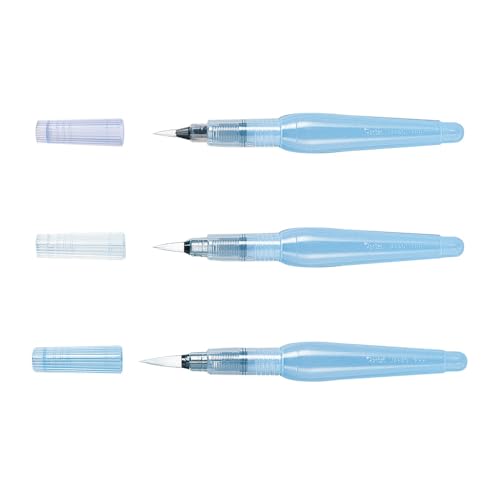
Pentel Aquash (water brush)
Brush with a water reservoir for painting with watercolour anywhere, no cup and no mess.
- Water reservoir
- Perfect for travel
- Several tip sizes
€ 15.15Price as of November 9, 2026 1:11 pm
Learn more for Pentel Aquash (water brush)Posca PC-3M: opaque paint for highlights and details
Posca plays in a different league. It is not an ink marker but a water-based acrylic paint marker, and its big difference is opacity: it covers dark colours, black paper and the colour of a Copic or Tombow. That is why it is widely used to add catchlights in eyes, shine on hair, sparkles, stars or white details at the end of an illustration.
It also works on paper, wood and fabric, so it is the natural choice if you want to customise objects, trainers or folders. The PC-3M has a fine tip, the most comfortable for details. Before using it, shake it and press the tip so the paint flows down.
Its weak point is blending: it does not make smooth gradients like a Copic. You work in layers, letting each one dry. It is also not the tool for colouring large areas with subtle shifts.

Posca PC-3M (set)
Opaque acrylic paint markers for highlights, details and all kinds of surfaces.
- Cover dark colours
- Work on paper, wood and fabric
- Water-based
€ 14,23Price as of noviembre 9, 2026 1:11 pm
Learn more for Posca PC-3M (set)Sakura Pigma Micron: the fineliner for inking
The Pigma Micron does not colour, it draws the line. It is a disposable fineliner with water-resistant pigment ink, available in several widths, and one of the most widely used for inking illustrations and comics. Its ink does not bleed through the paper and, once dry, holds up well under colour.
This is its big advantage over an ordinary pen: you can go over the line with Tombow and water or with watercolour without it running. With Copic, most illustrators use it without issues if they let the ink dry fully, although it is worth testing in a corner, because going over the line many times with alcohol can affect it.
If you want a more expressive stroke, with more contrast between thin and thick, the Pentel Pocket Brush is a good companion for brush inking.

Sakura Pigma Micron
The most widely used disposable fineliners for inking illustrations and comics.
- Waterproof pigment ink
- Several line widths
- Does not bleed through paper
€ 12.38Price as of November 9, 2026 1:11 pm
Learn more for Sakura Pigma Micron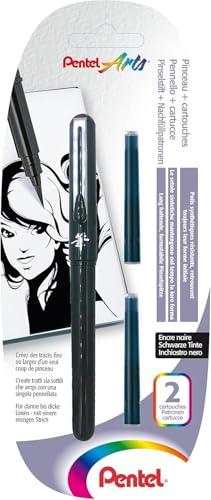
Pentel Pocket Brush
Synthetic-bristle brush pen with an ink cartridge for expressive strokes.
- Variable line
- Refillable
- Deep black ink
€ 15,23Price as of noviembre 9, 2026 1:11 pm
Learn more for Pentel Pocket BrushWhich to choose for your profile
If you draw colour illustration, comics or manga
Micron for inking and Copic for colouring. It is the classic combination because it gives you clean lines and professional gradients. Start with a small Copic set and expand with the tones you use most.
If you are into lettering
Tombow Dual Brush Pen, no question. The brush tip is what you need to practise thick and thin strokes, and the fine tip covers flourishes and small text.
If you draw in a sketchbook and travel
Micron plus Tombow. Neither bleeds through easily, they take up little space and you can blend with a water brush without carrying a cup of water.
If you want highlights, black paper or customised objects
Posca. It is the only one of the four that truly covers. Even if Copic or Tombow is your main tool, a white Posca is a very useful addition for finishing touches.
If you are starting out on a small budget
A couple of Microns in different widths and a basic Tombow set. They let you practise line and colour without the investment of a large Copic set.
How to choose markers for illustration
- Decide which part of the job each one covers. Line, colour, lettering or highlights. That way you do not buy two markers that do the same thing.
- Think about your paper. Alcohol needs thick smooth paper or dedicated marker paper; water-based ink needs paper that does not pill. Check our guide to types of paper for illustration before buying.
- Work out the long-term cost. Copic costs more at first, but it can be refilled. Tombow, Posca and Micron are replaced whole.
- Choose your palette wisely. To blend well you need tones from the same family, not lots of unrelated colours. Our colour theory for illustrators guide helps you build a short, useful palette.
- Test compatibility. Before a final piece, make a test strip with your line, your colour and your paper.
Prices change often depending on the set and the shop, so treat the references in this guide as approximate. As a rough idea, a single Micron is the cheapest, Tombow and Posca sit in a middle range and Copic is clearly the most expensive per pen.
For water-based markers and Posca, a smooth mixed media pad works well. You will find more options in the sketchbooks and notebooks section.

Canson Mix Media Imagine
Mixed media pad that handles markers, ink and light watercolour without buckling too much.
- For mixed media
- Smooth paper
- Good price per sheet
€ 7,13Price as of noviembre 9, 2026 1:10 pm
Learn more for Canson Mix Media ImagineConclusion: Copic vs Tombow, and where Posca and Micron fit
If you are only buying one colour system, the real decision is Copic vs Tombow. Choose Copic if you want smooth gradients and a professional finish in illustration and comics, and you do not mind investing more and using suitable paper. Choose Tombow if you are into lettering, want something cheaper and more versatile, or mostly draw in a sketchbook. Add a Pigma Micron for line work, because either one needs it, and a white Posca for the highlights no transparent marker can give you. You will find more supplies in the drawing supplies category.
Compare these 3 products side by side
Frequently asked questions
Which is better, Copic or Tombow?
It depends on the use. Copic is better for colouring illustration with smooth gradients, because its alcohol ink melts together without streaks. Tombow is better for lettering and light or watercolour-style colour, because its ink is water-based and its brush tip is very flexible.
Can you use Tombow and Copic together?
Yes, but in separate layers and with the ink fully dry. They do not blend with each other because one is alcohol-based and the other water-based. The safest approach is to test on your paper before working on a final piece.
Do Pigma Microns smear with Copic?
Their pigment ink is water-resistant and generally holds up well under alcohol markers if you let it dry. Going over the same line many times can affect it, so it is worth testing in a corner first.
What is a Posca used for in illustration?
Mainly to add opaque highlights and details at the end: shine, reflections, white lettering or elements on dark backgrounds. It also works for painting on wood, fabric and other surfaces.
Which markers should I buy for illustration as a beginner?
A couple of Pigma Microns for line work and a basic set of Tombow Dual Brush Pens for colour is an affordable, easy combination. Once you know you want more professional gradients, you can move on to Copic.
Some links on this page are affiliate links: if you buy through them, Ilustreando earns a small commission at no extra cost to you.
Leave a Reply